
Innovation at Work: Lessons from Projects that Didn't Go as Planned
“Innovation is synonymous with breakthrough. The new ideas, bold pilots, and creative approaches that drive change signify progress. Innovation prompts us to think ahead to what’s possible. But what can we learn by looking back at what had to break or fail before we could break through? Failure in innovation is not rare; it’s a critical part of the process that often reveals salient lessons about leadership, systems, and resilience.”
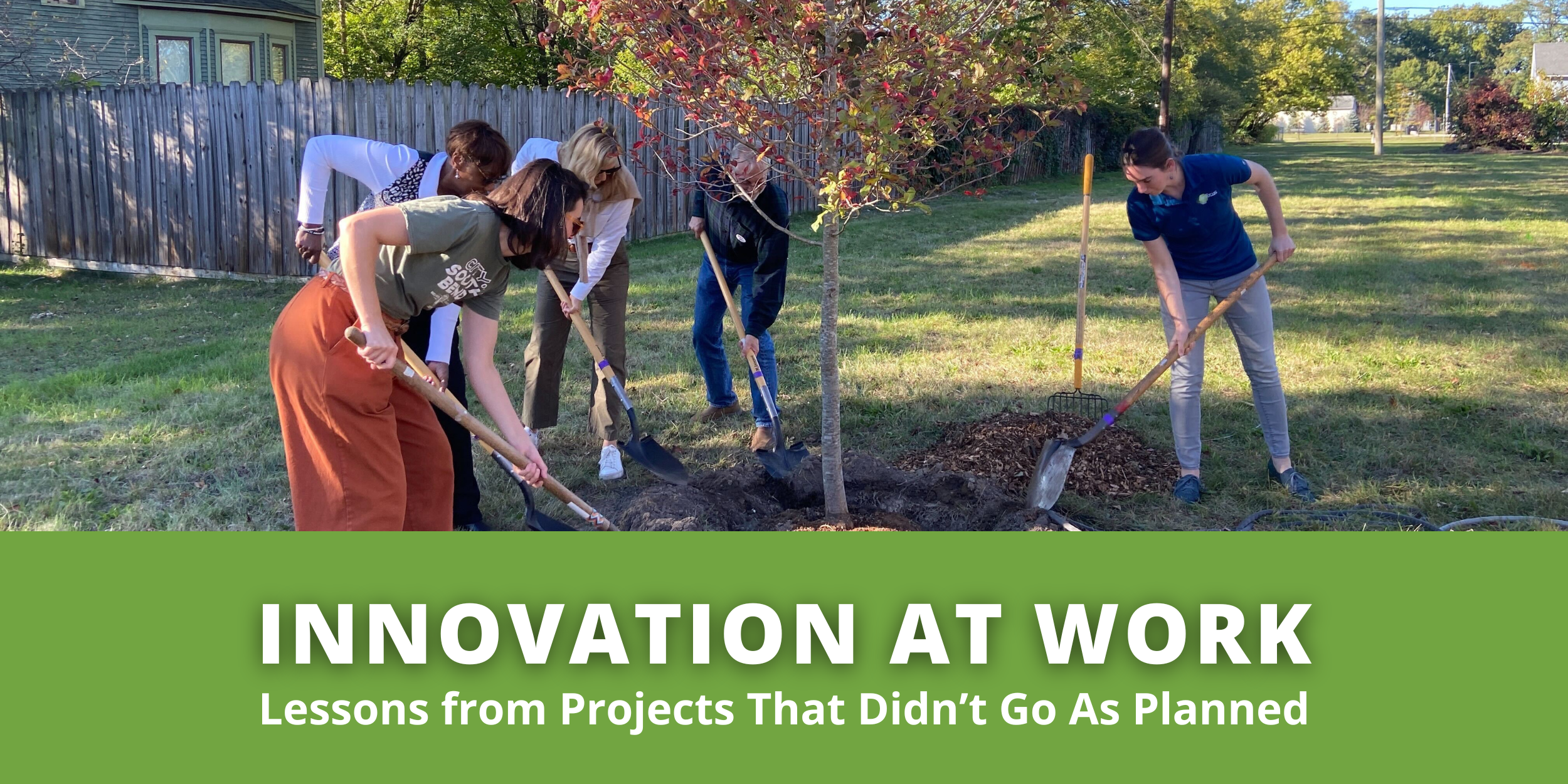
In June of 2024, enFocus was awarded three years of funding under the Environmental Protection Agency’s (EPA) Environmental Justice Collaborative Problem-Solving block grant to (1) engage and enroll residents into the Greener Homes Initiative and UpskillSB Climate Action Program and (2) design and execute a tree-planting initiative to increase South Bend’s urban tree canopy in historically disadvantaged areas. Designing these programs, let alone crafting a federal funding request, is a herculean effort that requires coordination across partners, precise planning, and a shared vision for impact.
Just months after the notice of award, in January 2025, an executive order was issued directing federal agencies to terminate grants related to diversity, equity, inclusion, and environmental justice.
In response, the enFocus project team proactively began condensing a three-year project into a few timely, strategic action steps. Within this context, innovation didn’t look like launching something new. Instead, it meant outlining contingencies and rapidly building the capacity to preserve as much impact as possible should the funding disappear.
Enter the climate capacity boost team, of which I was a member.
Amid the pervasive sense of uncertainty and urgency, it was key that our project workstreams—both new and existing—were coherent and complementary. Thanks to the steadfast, communicative leaders of this team, it quickly became apparent that no task was unwarranted or unimportant. We had team members analyzing alternative funding sources, identifying tree-planting locations, and conducting outreach to potential partners. Regardless of where the money came from, this project was moving forward.
My role on the expanded EPA project team was to template partnership agreements and sub-award contracts, allowing us to quickly and compliantly disburse funds to our community partners. I was unfamiliar with partnership agreements, and I knew even less about federal grant compliance. However, after copious hours of reading, several conversations with the team, and a prohibitive number of open tabs, I began synthesizing information into a standard template. A template, however, is only as good as the number of situations in which it can be utilized, and this edition was limited by its specificity. I turned to my teammates to understand the types of partners we were looking for, and I was inspired to create appendices so we could customize the parent template based on partners’ capabilities.
While I understood how these templates were helpful while the grant was active, a conversation with our project leaders revealed even broader applications. In addition to being critical, while we could access funds, the templates will expedite the partnership process for the remainder of the grant period, should the funding be reinstated. This will allow us to focus on progress instead of paperwork. Even if the grant was terminated before any federal funds could be disbursed, the templates could be adapted and used to disburse the alternative funds we were seeking. Moreover, should enFocus receive another federal grant, our organizational arsenal will include institutional knowledge and these templates to jumpstart progress. In other words, no matter the outcome at the federal level, my work was not in vain.
“Although useful, my work on this project was not glamorous. It was meticulous, consuming, informative, inspiring, and a reminder that sometimes “new ideas” aren’t the answer. It’s about rediscovering the basics: communication, clarity, and teamwork. ”
This project also highlighted the importance of adaptability in innovation. Building innovative, sustainable programs means designing for continuity as well as volatility. Ensuring adaptability and making adaptations strategically are paramount to an effective, resilient program.
“Finally, to paraphrase Samuel Beckett, my time on this project reminded me that innovation requires us to fail better. Each breakdown exposes a gap or assumption that needs to be rethought to precipitate a breakthrough. The goal isn’t to avoid failure but to fail better by learning from the pivots and anticipating the pitfalls.”
The EPA grant was ultimately terminated in late March 2025, but the team continues to plant trees, retrofit homes, and conduct outreach thanks to support from several key partners.
Our road to innovation is littered with best-laid plans, and this project is proof that when innovation “fails,” it can still yield progress in the form of the resilience and readiness of a team and community determined to deliver, regardless of the circumstances.